Terminal
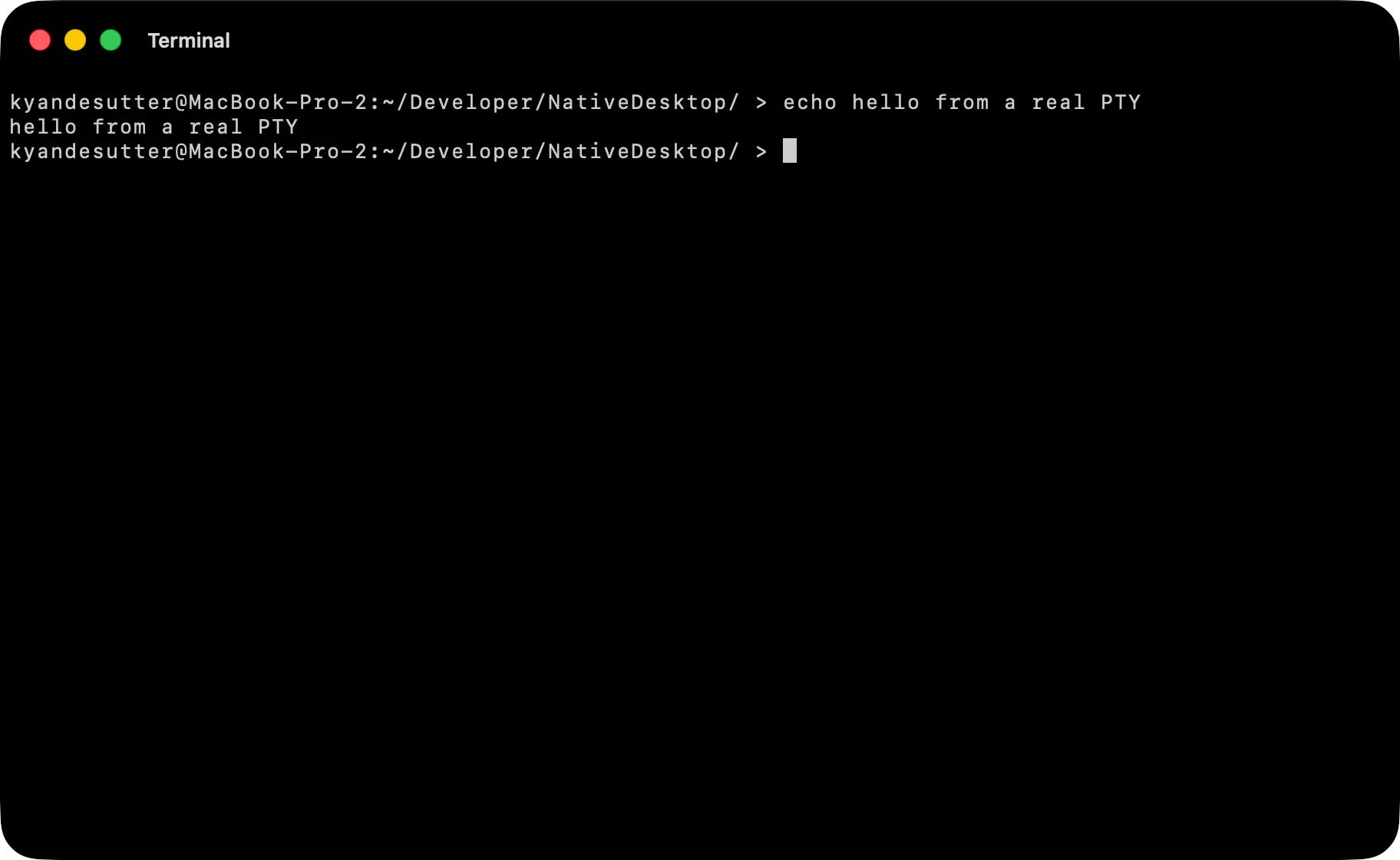
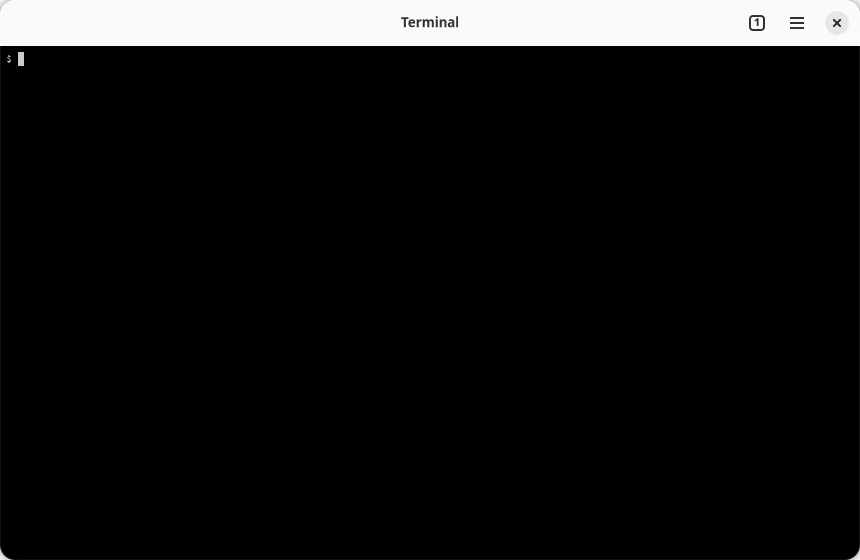
<terminal> embeds a real terminal emulator as a native drawing surface, backed by
libghostty-vt, the VT engine behind Ghostty. It spawns a PTY running your
shell, parses the escape-sequence stream into a cell grid, and draws that grid with the platform’s
own text stack: CoreText on macOS, cairo and Pango on GTK. Keystrokes go straight to the PTY.
import { render } from "@nativedesktop/react";
function App() {  return (    <window title="Terminal" defaultWidth={720} defaultHeight={460}>      <terminal cols={80} rows={24} fontSize={13} />    </window>  );}
await render(<App />);
That is a working terminal with no native code in your app. Type at the prompt, run vim, get
colors and a cursor.
| Prop | Type | Default | Notes |
|---|---|---|---|
command |
string | $SHELL |
Program to run in the PTY. Falls back to /bin/sh. |
cwd |
string | inherited | Working directory for the spawned program. |
fontSize |
number | 13 |
Point size of the monospace cell font. |
foreground |
string | #cccccc |
Default text color, #rrggbb. |
background |
string | #000000 |
Default grid color, #rrggbb. |
cols |
number | 80 |
Initial columns. |
rows |
number | 24 |
Initial rows. |
The two color defaults are byte-identical on both backends and do not follow the system theme, so a terminal stays dark under a light appearance the way Terminal.app and GNOME Console do. A color you pass wins. On macOS, a terminal that spans its window also tints the window background to its own background color and picks the titlebar appearance from that color’s luminance, so a dark grid gets no white band above it.
All props are create-time. The terminal owns its PTY for the life of the widget, so changing a
prop means remounting with a different key. Keystrokes are handled host-side and fed straight to
the PTY, never crossing NDP, which keeps the interactive hot path off the socket.
How it works
Section titled “How it works”Three layers, split the way Ghostty splits its own core from its app runtime:
libghostty-vtis emulation only. It parses the VT stream and maintains the grid, scrollback, cursor, colors, and reflow. It does not spawn a PTY, render, or touch OS input.- The
ndtermcore (src/core/terminal.zig, GTK-free) owns those three. It runsforkpty, pumps the PTY intolibghostty-vton a reader thread behind a mutex, and exposes a flat C ABI (include/ndterm.h):ndterm_open/close/resize,ndterm_write_input(bytes), and a lock-snapshot render model (ndterm_render_lock→ndterm_cell(x, y)/ndterm_cursor→ndterm_render_unlock). - The surface is the only per-backend piece: a
GtkDrawingAreapainting cells with cairo on Linux, anNSViewpainting with CoreText on macOS. Both inset the grid 6 points from the widget edge so column 0 is not cut by the frame, and both call only thendtermC ABI.
libghostty-vt ships as a prebuilt static library under vendor/libghostty-vt/, built once with
the Zig 0.15 toolchain it targets and linked as a plain C archive, so it stays independent of the
repo’s pinned Zig 0.16. Nothing is downloaded at build or run time.
Remote mode
Section titled “Remote mode”With remote, the widget spawns no PTY. The host process dials a byte-lane TCP server itself and
feeds the terminal from that stream, so raw bytes never cross the app’s JS bridge:
<terminal remote host="127.0.0.1" port={4618} sessionId={id} ticket={ticket} />host, port, sessionId, and ticket are create-time props like everything else on the widget:
to attach with a different ticket or session, remount with a different key.
Connection sharing is keyed by host:port:ticket. Terminals opened with the same ticket share one
TCP connection and the server assigns each an attach channel. A different ticket always gets its
own connection and reader thread, even to the same endpoint, so a stale connection never blocks a
fresh attach and one terminal’s grant never limits another’s.
The connection auto-reconnects with backoff and replays its ticket on each attempt. Progress
arrives through onConnectionState, where data.state indexes connecting, authed, attached,
reconnecting, failed, closed (the nd_rt_state order in include/ndremote.h). failed is
terminal for that connection: the server refused auth or attach, so retrying the same ticket cannot
succeed. Mint a fresh ticket and remount.
Not implemented yet
Section titled “Not implemented yet”The terminal renders the grid and routes keyboard input on both backends. Terminal-initiated events
back to React (title changes, bell, child exit) are raised internally by the core but not yet
surfaced as onTitle/onBell/onExit handlers. Mouse reporting, IME and dead-key composition, and
live font-size changes are also outstanding.